By: Tia Ayele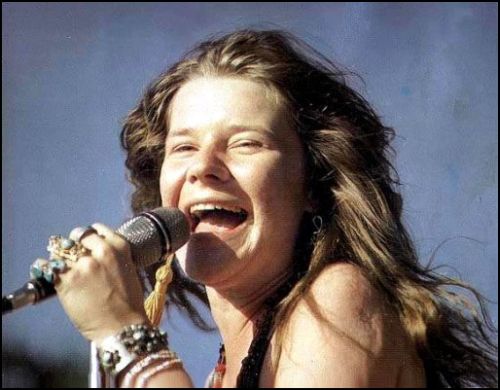
Since what seems to be the beginning of time, the ubiquitous nature of male privilege in every facet of our society has solidified patriarchal normalization, blinding us to patriarchy and its penetrating effects on social norms. Today, the problem is no different. We even see patriarchy playing an active role in our legislative process, with the definition of rape and the rights of a woman’s body being issues open for debate. Confronted with these overwhelming instances of gender inequities, it would be of benefit to reflect on the life of Janis Joplin, a pioneer of rock-and-roll and arguably one of the most influential female artists in history.
Aside from her role as a female rock-and-roll artist, Janis Joplin was a nonconformist with a vision of changing the limiting patriarchal norms of society. As an integral part of the Counterculture movement of the 1960s, an era marked by the widespread dissemination of hallucinogenic drugs and free love, Joplin attempted to affect change through the reflection of her own life. She chose to do what she felt was inherently right and real, with little worry of what others thought of her along the way.
The biggest forces that Joplin reacted against were ones related to the constrictive traditional gender roles of her time. In the era in which Joplin grew up and even in which she rose to fame, social expectations for women were extremely limited. Although the women of the 1960s were no longer confined to their former roles as homemakers and were beginning to enter the workforce, female submissiveness remained a widely accepted social norm. Even in the workplace, women were paid significantly less than their male counterparts and were constantly facing sexually harassment. Despite the shifting role of women in the household and women’s newfound allowance of economic independence, women were still perceived to be socially inferior to men.
Joplin rebelled against these traditional gender roles by emulating characteristics that were conventionally designated for males. From the time that Joplin first started singing in local coffee houses in Houston, Texas to the time that she performed for thousands with the Big Brother & the Holding Company, Joplin maintained an unapologetically tough persona. She had an instinctively bold personality about her that was almost aggressive in nature. Her projection of this rough and untamed image was a far cry from the societal expectations of feminine behavior. Although Joplin’s persona was often associated with masculinity and her ability to become “one of the guys”, Joplin was not attempting to imitate men. Joplin also embraced qualities about herself that were thought to be inherently feminine, such as her vulnerability and her spouts of sensitivity. Through infusing her image with feminine qualities, Joplin forged a new female identity that could be simultaneously tough and feminine, thus creating her own form of female strength that was distinctively different but equivalent to male strength.
Even more telling of Joplin’s nonconformist ways were the lyrics in her songs, which undermined the conventional musical paradigms for female artists. Although her lyrics dealt with typical themes of romance and love, Joplin went beyond the usual surface in describing romantic relationships. Rather than playing the role of the victim, the traditional role of women in the arena of love, Joplin took a more assertive role in expressing her romantic desires. One example of this is in her song, “Piece of My Heart”, which involves Joplin singing of a man who takes a piece of her heart every time she gives into him. In the lyrics, Joplin ends the first verse by saying “I’m gonna show you, baby, that a woman can be tough”, explicitly warning her lover of her strength. In the hook of the song, Joplin shouts “Take it!”, in reference to her heart, which demonstrates her assertiveness in dealing with her lover. Although Joplin clearly wants her lover to take a piece of her heart, she is not passively giving it away; she is actively demanding that her lover follow her orders. Through her assertive lyrics, Joplin demonstrates her power as a woman and proves that she can be an active romantic force.
Above all, the most radical element of Joplin’s image was her constant promotion of sexual freedom. Through her lyrics, publicly made comments, and sheer attitude, Joplin was an obvious symbol of sexual liberation. Her lyrics were often times strongly sexually charged, as exhibited in songs such as “One Night Stand” and “Blow my Mind”. In the upbeat track of “C’mon Baby, Let the Good Times Roll”, Joplin playfully sings about sex and fun with a lover that she has missed. In this song, and in many others, Joplin openly sings about having sex and enjoying it. With phrases such as “let’s ride some more” and “rock me all night long!”, Joplin makes sex appear to be an exciting recreation. Aside from her sexually driven lyrics, her very stage presence was sexual in itself. On stage, Joplin would aggressively thrust her hips around and dance in motions that were deemed hyper-sexual. Her dances accompanied with her natural groans and moans while singing projected a strong sense of her connection with sex and the wild elements of rock-and-roll. Joplin was extremely aware and embracing of her wild image, reportedly saying once that “my music is supposed to make you want to f***”.
However, this same image drew lots of criticism, especially from more conservative audiences. Promoters in Houston, Texas went as far as banning her music altogether on the radio due to her vulgarity. Moreover, Joplin was even arrested once for using indecent language at a concert. Despite the conservative backlash, Joplin further promoted her sexually promiscuous image. On stage, she continued to perform in a manner deemed indecent; off stage, she practiced free love with various sexual partners of her choosing.
Although Joplin was bold enough to confront the social constrictions that she felt were limiting, Joplin was not as emotionally strong as her persona would suggest. Joplin was haunted by deep-rooted insecurities that traced back from her childhood, and having tried heroin for the first time in the early sixties, Joplin, like so many other musicians, developed a heroin addiction. Despite her many attempts at coming clean off of heroin and at rehabilitation, her drug habit grew worse after her split with Big Brother & the Holding Company in 1968. Unfortunately, two years later, her heroin addiction would prove to be her ultimate demise. Joplin died on October 4, 1970 at a Hollywood hotel after a bad deal of heroin. Her untimely death shocked the music industry and the world.
In just twenty-seven years, Joplin successfully made her mark on the world, with her non-conforming attitude and individual style. Although some parts of her life are more commendable than others, it is apparent that Janis Joplin served as a model for women everywhere. Through her audacity and spunk, Joplin helped reshape the idea of what a woman could be: tough, sexually liberated, and above all, nonconforming.
Her radically unorthodox lifestyle and her refusal to submit to patriarchal norms can teach us a great deal of how to reverse our current conception of gender identity. Just as Joplin had, we must conceptualize gender in a different way and debunk the widely accepted beliefs that reaffirm our patriarchal system. Because we are all participants in the system of oppression, we all have the power to reshape the system in how we participate in it. The first step is to become more aware as a society of the inequities that subjugate us and the privileges that we all inherit in some way. If we become sensitive to these factors, then we can begin to dismantle the system of oppression and to reconstruct a more egalitarian social framework for gender equity.